
From Theory To Machine: Building Afrocentric STEM Competence Through Hands-On Fabrication
By: Enock Nthiwa Kaunda, Mapunga High School.
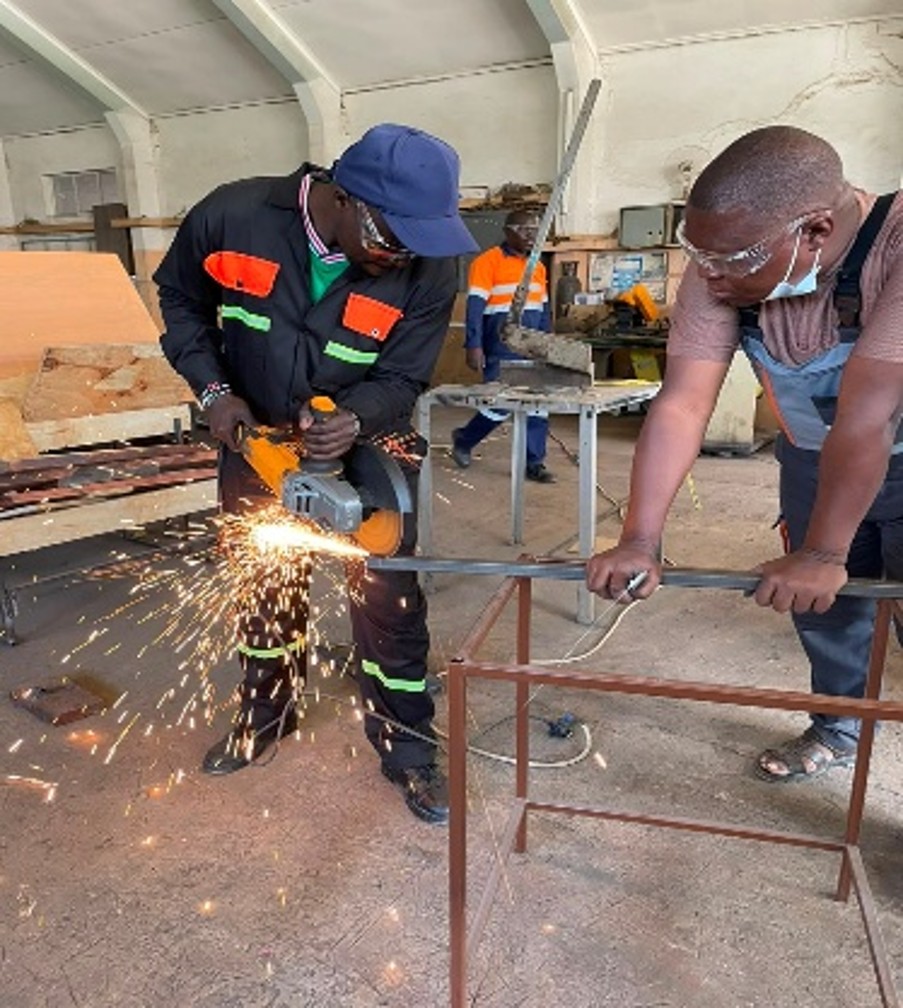
When I arrived in Lusaka, Zambia for the 2026 Afrocentric Knowledge Co-Creation Programme (KCCP), I expected advanced pedagogical discussions. What I did not expect was a complete redefinition of how STEM education can be delivered in African contexts. The training, hosted by Zambia’s Directorate of National Science Centre (DNSC) in partnership with JICA, brought together educators from 18 African countries under the theme Afrocentric Competence-Based STE(A)M Education Transformation.
As a Physics teacher, I had taught concepts like heat transfer, mechanics, and electricity using textbooks and diagrams for years. But the 2026 KCCP challenged us to move beyond theory. We were organised into groups and tasked with designing and fabricating actual learning environments using low-cost, locally available materials. I was assigned to the Agro Machinery Group, where we built four functional machines: an Incubator, Dehuller, Grinding Mill, and Pellet Maker.
From Theory to Practice
For 280 contact hours, we did not just talk about STEM; we lived it. Mathematics guided every measurement. Physics shaped every mechanical and electrical decision. Biology informed the incubator’s temperature and humidity controls. Agriculture influenced our understanding of maize processing and feed production. Every subject converged in every machine. The project demonstrated that real-world problems do not respect subject boundaries; and neither should our teaching.
Competence Through Creation
The project followed a clear learning process: Explore → Plan → Create → Test → Improve → Share. We engaged in collaborative problem-solving, addressing challenges like alignment issues, electrical integration, and material constraints. We worked in subgroups, presented to plenary, and learned from each other; embracing the spirit of Ubuntu.
The four machines now stand as tangible evidence of what Afrocentric STEM education can achieve. The incubator, with its 2,115 eggs capacity, is designed to address food security challenges. The dehuller reduces post-harvest losses by processing maize efficiently. The grinding mill produces flour for household consumption. The pellet maker converts agricultural waste into valuable animal feed; demonstrating how “waste” can become a resource.
Lessons for Competency-Based Education
The Agro Machinery experience taught me that competence is not developed through lectures; it is forged through doing. Learners develop critical thinking when troubleshooting alignment issues. They learn collaboration when working in subgroups. They build creativity when proposing design modifications. They understand entrepreneurship when seeing income-generating opportunities in the machines they build.
The Way Forward
The 2026 Afrocentric KCCP proved that African educators can create world-class learning environments using locally available materials and indigenous knowledge. But this requires intentional investment in teacher professional development, workshop infrastructure, and community partnerships.