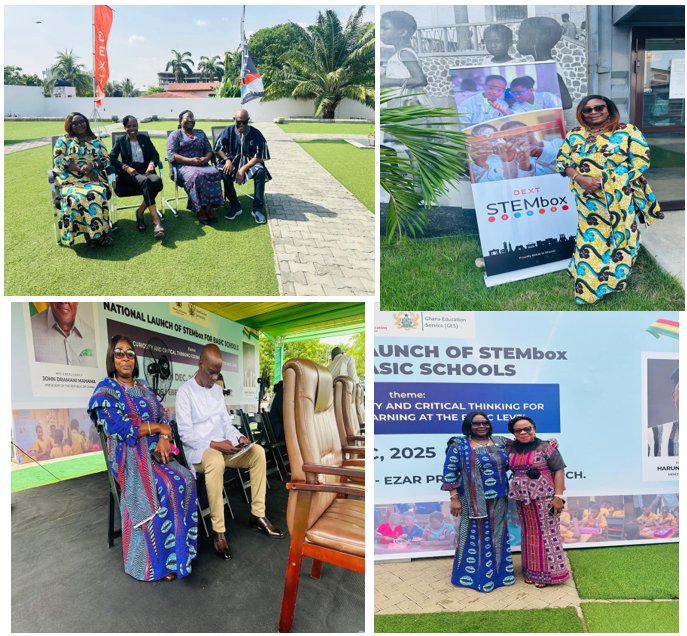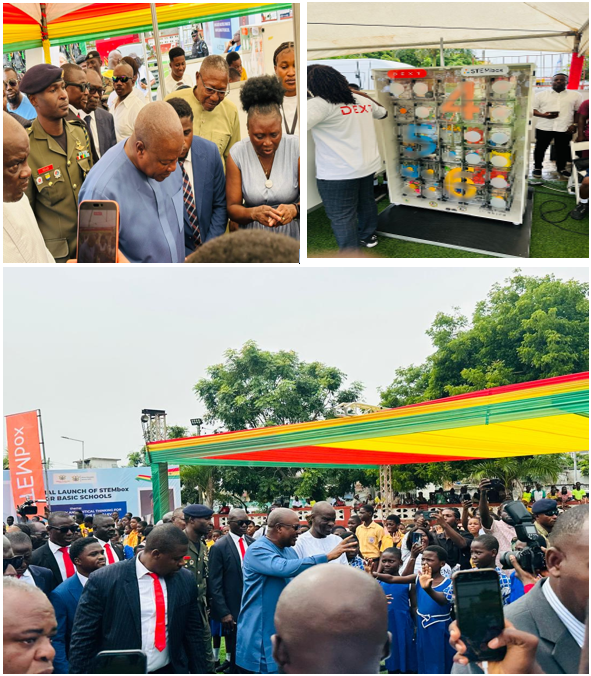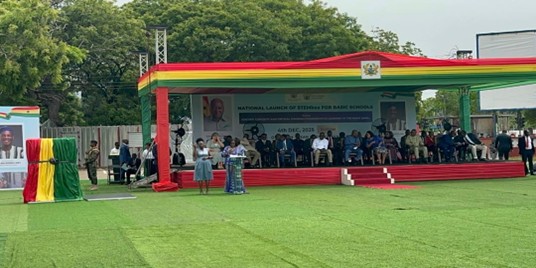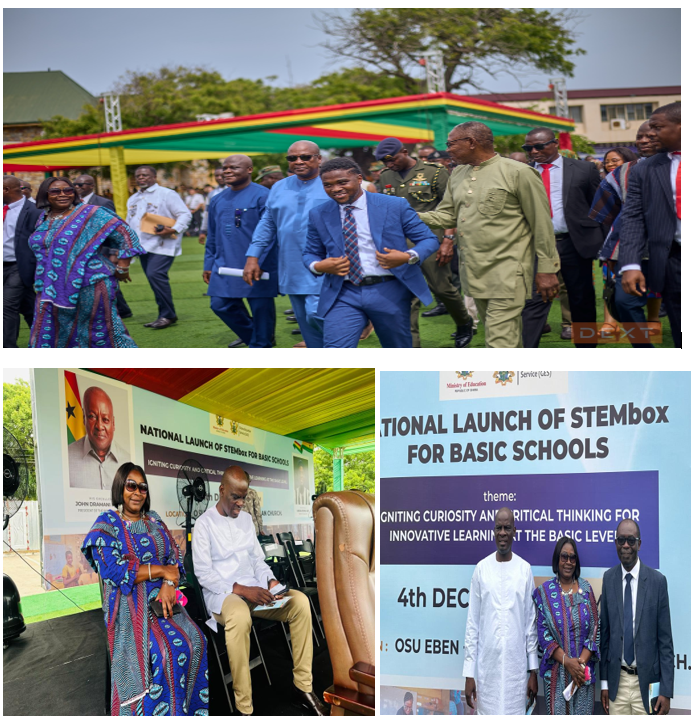
Presidential Launch of The DEXT STEM Box: Advancing Practical and Robotics-Based STEM Education in Ghana
Author: Olivia Serwaa Opare (Mrs.), Director, Ghana Education Service – National STEM Resource Unit
Summary
Ghana has launched the DEXT STEM Box, a flagship national initiative under the Ministry of Education and the Ghana Education Service, aimed at strengthening hands-on STEM education in basic schools. Launched by H.E. John Dramani Mahama, President of the Republic of Ghana, on 4 December, the locally manufactured STEM Box will pilot in 667 basic schools nationwide. The initiative is designed to enhance curriculum-aligned practical learning for Basic 4–6 and introduce robotics at the basic level, marking a significant step toward preparing Ghanaian learners for a technology-driven future.
Keywords
STEM education; DEXT STEM Box; Practical learning; Robotics education; Basic schools; Ghana Education Service; Curriculum implementation; Local innovation
Introduction
Strengthening Science, Technology, Engineering, and Mathematics (STEM) education remains a strategic priority for Ghana’s education sector, particularly at the foundational levels. In response to persistent challenges relating to limited access to practical teaching and learning resources in basic schools, the Government of Ghana has introduced the DEXT STEM Box as a nationally coordinated intervention to deepen experiential learning and support effective curriculum delivery.
The Presidential Launch of the DEXT STEM Box on 4 December represents a policy-driven effort to reposition STEM education as a practical, learner-centered enterprise capable of nurturing creativity, problem-solving, and innovation from an early age.
Background and Policy Context
The DEXT STEM Box is a flagship project under the Ministry of Education and the Ghana Education Service, aligned with Ghana’s standards-based curriculum and ongoing reforms to promote inquiry-based and competency-driven learning. The initiative reflects global and continental best practices that emphasize hands-on STEM education as essential for building 21st-century skills and national human capital.
Design and Scope of the DEXT STEM Box
Designed to serve learners in Basic 4 to Basic 6, the STEM Box provides a comprehensive collection of materials required to deliver curriculum-aligned practical sessions in science, technology, and engineering. By consolidating essential equipment into a single, classroom-ready kit, the intervention supports teachers to move beyond theory-based instruction toward active experimentation, observation, and problem-solving.
A distinguishing feature of the DEXT STEM Box is its integration of robotics teaching and learning at the basic school level. Through structured and age-appropriate activities, learners are introduced to computational thinking, logical reasoning, and foundational engineering concepts, consistent with international trends in early STEM education.
Pilot Implementation
The initial phase of implementation will pilot the DEXT STEM Box in 667 basic schools across Ghana. This pilot phase is intended to generate evidence on classroom integration, teacher readiness, and learner outcomes, providing a basis for refinement and potential nationwide scale-up.
Innovators and Institutional Collaboration
The STEM Box is locally designed and manufactured by DEXT Technology Limited, a Ghanaian education technology company. The initiative is led by DEXT Technology Limited in collaboration with national education institutions, including the Ghana Science Resource Centre. Notably, the project has been championed by the leadership of DEXT Technology Limited, including its Vice President, Mr. Caleb Fugah, reflecting strong private-sector engagement in advancing public education goals.
National Significance and Outlook
Speaking on the significance of the initiative, the Government of Ghana has emphasized that the locally manufactured STEM Box reduces cost barriers, promotes local innovation, and ensures equitable access to quality STEM learning for all Ghanaian learners, regardless of location.
Overall, the Presidential Launch of the DEXT STEM Box represents a systemic investment in Ghana’s STEM education ecosystem. By aligning curriculum delivery, teacher practice, local manufacturing, and emerging technologies such as robotics, the initiative positions Ghana to strengthen STEM foundations at scale while contributing meaningfully to Africa’s broader STEM education transformation agenda.
Acknowledgement
Gratitude is respectfully extended to His Excellency John Dramani Mahama, President of the Republic of Ghana, for his support and approval of the DEXT STEM Box initiative. His Excellency’s leadership and commitment to strengthening STEM education and innovation-driven national development have been instrumental in enabling the realization and Presidential launch of this flagship intervention.
The successful conceptualization and Presidential launch of the DEXT STEM Box initiative has benefitted from strong national leadership and policy direction. Foremost appreciation is extended to the Hon. Haruna Iddrisu, Minister for Education, for his commitment to locally driven, equitable, and future-oriented STEM education, and for providing the strategic policy oversight that continues to shape Ghana’s STEM education agenda.
Special acknowledgement is also accorded to Prof. George K.T. Oduro, Technical Advisor to the honorable Minister for Education, for his expert guidance and advisory support in shaping strategic STEM interventions. His contributions have been critical in aligning technical innovation, policy intent, and practical implementation within Ghana’s STEM education reform agenda.
Further acknowledgement is extended to the leadership of the Ghana Education Service, led by Prof. Ernest Kofi Davis, Acting Director-General of GES, for providing institutional guidance and administrative support for the implementation of national STEM interventions. The contributions of the Deputy Directors-General; Prof. (Mrs.) Smile Gavua Dzisi (Management Services) and Dr. Issahaque Munawaru (Quality and Access), are equally recognized for their roles in strengthening governance, quality assurance, and equitable access within Ghana’s basic and secondary education system.
Gallery