
Innovation Spotlight – Kitagata Secondary School (Bushenyi SESEMAT Region)
Project Title:
Making an Automatic Water Dispenser Using Local Materials to Prevent the Spread of Contagious Diseases like Flu, Cough and COVID-19
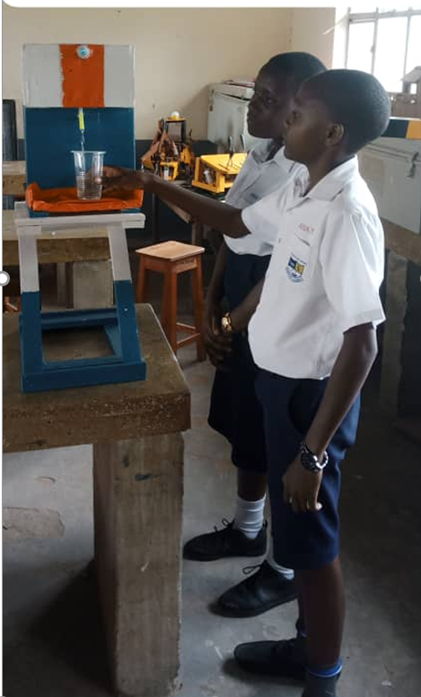
Innovators
Tumwebaze Musa & Ayebazibwe Winfred- Kitagata Secondary School-Uganda
“This innovation proves that the future of STEM in Africa is not found in imported technology — it is already in our classrooms, in the minds and hands of students like Musa and Winfred.”
Kitagata Secondary School shows that innovation begins when learners are trusted to think.
1.0 Problem Statement
We observed that in our school and community, access to clean and safe water is still a challenge. During times when diseases like flu, cough, influenza and COVID-19 are common, many people use the same water source and touch the same containers when washing hands. This increases the chances of spreading infections from one person to another.
As students, we learn science and mathematics in class, but we noticed that these subjects are rarely used to solve real problems in our communities. We wanted to change this. We asked ourselves:
Can we use the knowledge we learn in class to prevent disease transmission and promote hygiene?
This inspired us to design a low-cost automatic water dispenser using local and recycled materials, to reduce contact and improve hygiene. Through this innovation, we want to show that even with limited resources, learners can use STEM skills to solve real-life problems and make a positive impact in society.
2.0 Objective
To develop and pilot a low-cost automatic dispenser in Kitagata Secondary School and one nearby health facility within one academic term, using only local materials.
3.0 Design Stage (Modelling the Solution)
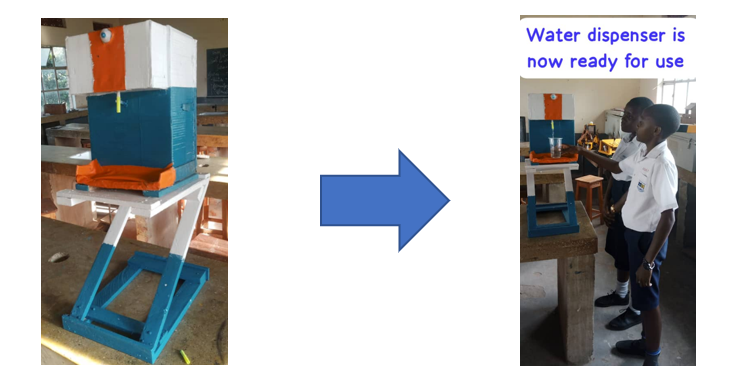
After identifying the problem, we began modelling our solution using the STEM concepts we had learned in class. We first sketched a simple structure and explored possible ways of activating water without touching the container. From this exploration, we developed a portable and low-cost automatic water dispenser, built entirely from locally available and recycled materials, as shown in our work.
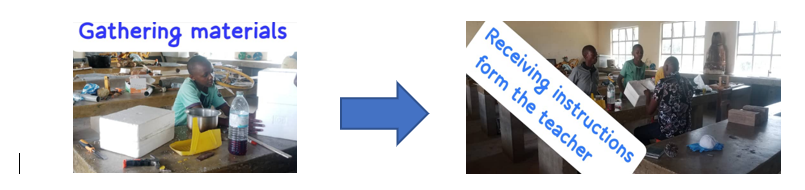
Our design includes:
- Simple electrical circuit system for activation,
- Battery-powered motor
- Manually controlled circuit instead of expensive sensors, and
- Lightweight frame that can be moved to different places within the school.
This model shows that STEM can be applied even without factory-made parts or expensive materials.
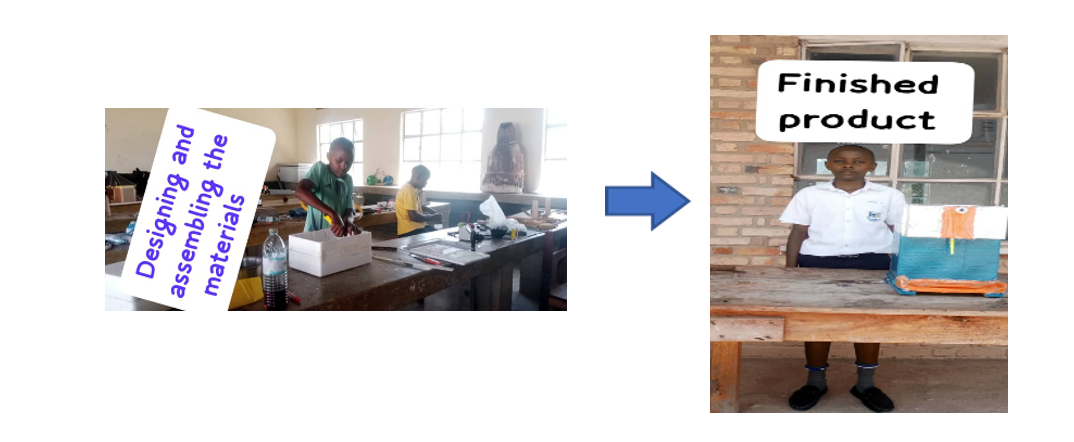
3.1 Materials used:
In designing this dispenser, I used:
- Plastic bottle: used as the water reservoir.
- Cardboard: used for constructing the base and housing for the internal parts.
- Adhesive glue, cello tape: to hold the components together.
- Jerry can sealers: for making the outer part of the water pump.
- PVC off-cuts: to make the turbine of the pump.
- Motor: to convert the electrical energy to mechanical energy. This turns the turbine that sucks and pushes the water within the pump.
3.2 Construction Process (Making the Automatic Water Dispenser)
a) Preparing the Pump Materials: plastic jerry can sealers and a flat plastic sheet
- Shaping: draw and cut a circular piece with a smaller radius than the jerry can sealer
- Motor installation: fix the motor inside one of the jerry can sealers using melted glue
- Turbine connection: attach the turbine to the motor axis and ensure it rotates freely
- Pipe connections: fix the inlet and outlet pipes to the pump cover
- Sealing: use another jerry can sealer to close the pump tightly—seal with melted glue to eliminate air spaces
b) Making the Outer Frame: Construct the rectangular body using cardboard
Dimensions: height 38 cm, width 19 cm, length 25.5 cm
Add a nozzle-like structure at the top for the water outlet
c) Electrical System Setup Switch connection: connect a click-switch to the battery and water pump motor. The circuit is completed when pressure is applied using a glass or an object.
Battery installation: Use a portable battery to power the pump motor
Alarm system: connect an alarm to the battery and reservoir. A float switch triggers the alarm when the water level drops too low.
d) Testing & Refinement: Test the dispenser to confirm smooth operation
- Calibrate the water level controller when necessary
- Reset the alarm mechanism to ensure accurate detection of low water levels
3.3 Functional Explanation (How the Product Works)
The water dispenser functions as a system made up of coordinated parts:
- Battery – supplies electrical power
- Motor – drives the turbine
- Turbine – creates suction pressure within the pump
- Atmospheric pressure – forces water into the pump
- Outlet pressure – pushes water out when the circuit is activated
- Indicator light – confirms successful operation of the pump
- Alarm system – activates when water level becomes too low
When the switch is pressed, the motor powers the turbine. Negative pressure is created inside the pump chamber, allowing atmospheric pressure to push water inward. The motor continues to drive the turbine, which forces water through the outlet pipe. A light signals successful functioning. If the water level drops below a certain point, the float switch triggers the alarm to remind the user to refill the reservoir.
3.4 Advantages to the user
Table 1: Comparison Between Student-Made Water Dispenser and Commercial Dispenser
| Feature / Aspect | Student-Made Dispenser (Kitagata) | Commercial / Factory-Made Dispenser |
| Cost | Very low – made using local & recycled materials | High – requires imported or industrial components |
| Power Source | DC battery (cheap & accessible) | Mostly AC electricity – higher cost & limited access |
| Contactless Dispensing | Manual circuit completion – no sensors needed | Uses expensive infrared or touch sensors |
| Alarm System | Built-in local alarm for low water level | Rarely included unless premium model |
| Portability | Light and mobile – can be used in class, playground, staffroom | Usually fixed in one position |
| Energy Consumption | Very low – runs on DC | High – requires constant electricity |
| Maintenance | Easy to maintain and fix locally | Requires technician or company support |
| Use of Local Materials | 90% made from recycled or locally available materials | Mostly imported components |
| Environmental Impact | Reduces plastic waste & carbon footprint | Produces waste from bottle packaging & transport |
| Community Value | Promotes STEM learning & innovation | Mainly commercial use – no learning value |
| Accessibility in Rural Areas | Can work without electricity grid | Limited where electricity is unavailable |
| Customization | Can be redesigned for school needs | Standardized factory models – little flexibility |
Our model proves that innovation can be achieved with local materials, simple circuits, and creativity. We wanted to demonstrate that learners do not have to wait for expensive technology to solve problems — they can build it themselves.
3.5 Challenges with the Product
1. No Internal Filtration System
The dispenser currently requires already-filtered water because it does not have an automatic internal filtration mechanism.
2. No Temperature Regulation
The dispenser only serves water at room temperature. It does not provide options for hot, cold, or warm water, which limits user preference and functionality.
3.6 Future Improvements (Mitigation Plan)
In the next edition of our dispenser, we plan to:
- Install an internal filtration system to make the dispenser fully independent and safe for raw water.
- Add temperature control features so that users can select hot or cold water depending on their needs.
- Explore the use of solar power and sensors to enhance efficiency and reduce running costs.
These improvements will make the product more effective, user-friendly, and closer to commercial standards while still remaining affordable for schools and communities.
4.0 Potential Users & STEM Integration
4.1 Who Can Use This Product? (Target Users)
| Target User | Possible Use |
| Schools | Can be placed at water points or inside classrooms. Because it is portable and low cost, it is suitable for everyday school use. |
| Hotels | Can be used to serve drinks and reduce labour costs. It also removes the need for manual replenishment. |
| Offices | Helps staff stay hydrated. Its smart design makes it suitable for office environments. |
| Homes | Can be used for drinking water, kitchen use, or even in bathrooms. |
| Hospitals | Since it is contactless, it reduces the risk of spreading contagious diseases such as flu and cough, making it suitable for healthcare settings. |
4.2 Integration with Other Subjects
| Subject | How It Is Applied in This Innovation |
| Mathematics | Used to calculate the volume of the water tank, flow rate, dimensions of the frame, battery ratio, and cost estimation of materials. |
| Physics | Used to understand pressure differences, suction force, fluid movement, and energy transfer from the battery to the motor. |
| Chemistry | Understanding the properties of plastic materials, battery chemicals, and the possible future addition of water filtration systems (acid-base reactions, purification). |
| Biology | Explains the importance of hygiene, disease transmission, and how germs spread through shared surfaces. Supports the need for contactless dispensing. |
| ICT | Future upgrades may include sensor automation, programming for microcontrollers, alarm systems, and digital monitoring of water levels. |
| Art & Design | Applied in the physical appearance, colour choices, user-friendly shape, and creation of a clear visual prototype. |
| Entrepreneurship | Opportunity for local production, cost reduction, business planning, marketing, product pricing, and identifying customer segments. |
| Geography | Promotes sustainability by using recyclable materials and reducing carbon emissions from factory-produced bottled water. |
| Health Education | Supports hand hygiene, disease prevention, and infection control in schools, hospitals, and communities. |
| Design & Technology | Used in constructing models, choosing appropriate materials, and planning how each part fits functionally. |